

Forums › Forums › SOLAR FORUM UK › Adding battery to current solar setup
Tagged: Solar Battery, Solar Inverter, solar uk
-
Adding battery to current solar setup
Posted by Annabel Stanley on March 11, 2026 at 11:09 amAdding battery to current solar setup
We have solar panels but no battery. Looking to potentially get a battery fitted but feel a bit lost looking at the different sizes and brands. Can anyone give me some basic advice on how to work out minimum or ideal battery size?
Nicholas Carey replied 1 month ago 14 Members · 19 Replies -
19 Replies
-

First you need to know if a battery can be connected to your inverter?
-
It should have the details on the inverter itself. Or take pictures and post on here and I’m sure someone will know.
-
One further consideration, as has been said there needs to be a CT clamp on the incoming supply connected to the new inverter. It isn’t a massive problem but logistically it’s more difficult if the consumer unit is not in the garage. It might be better to fit the battery outside with suitable protection if it can be closer to the consumer unit. I personally don’t like batteries outside but many are suitable for use that way. It really depends what works best in the circumstances.
That creates a problem for the siting of batteries anyway irrespective of the type. Current guidance is not to fit batteries in a loft. If power is accessible in the garage I would suggest housing the batteries there and to use a seperate inverter that charges the batteries then works in reverse to power the house. As you have solar already and likely an export limit the installation will need a G99 application to the DNO. Any good installer will understand. It’s because both the solar and battery inverter will be able to export even if set to zero in software.For your usage I would look at around 10kWh of storage, it will see you through the day most days.
-

What inverter do you currently have? Is it a hybrid or standard inverter?
What’s your average daily usage in kWh during winter?
-

Every property and family is different. You are looking for an AC connected battery, this means that there is an additional inverter that looks after the battery only. As a rule of thumb, an average family will fully utilise a 5kw battery every day, as getting a 10kw doesn’t cost that much more and will be used most days it is a sensible choice. Beyond that it becomes nice to have for some of the year, mainly winter where you will charge over night. The limit comes when the inverter can not fully charge the battery size in the cheap rate time period. I hope that makes some sense. Feel free to DM me to discuss you actual needs
-

you haven’t mentioned the age of your solar array so don’t know if it’s on a FIT or not, so I’ll answer as if you are and you can ignore that bit if it’s a non-FIT system
In terms of sizing batteries, they should be sized based upon your daily grid consumption minus a bit. The bit is 2 parts
1. How much your solar will generate on its worst days (typically 10% of the solar capacity times fewest hours in the day (so for a 3.6kwp system about 360w * 4 hours or around 1.5kwh).
2. How much you consume off-peak as batteries also aren’t used then as they’re typically charging.
I consume 8-10kwh a day, I have a 5.2kwp array and my battery is 7.2kwh
One caveat to this is if you have access to an off-peak tariff that has multiple slots (ie Octopus Cosy which has three slots), as each slot will let you charge up the battery, meaning you get multiple uses of your battery over day. So a 10kwh battery could give you 30kwh of usable off-peak capacity per day.
Knowing your battery size you can then consider adding a battery to an existing system in one of 2 ways, either swapping out the existing solar inverter for a hybrid and then connecting the batteries to it, or adding the batteries as AC coupled (batteries have their own inverter).
The Hybrid option is the easiest as it doesn’t require additional circuits in the consumer unit, but it needs a little reading if you receive a FIT as there are some rules to follow to make sure you don’t lose the FIT payments. So have a read and then decide what might be best.
-

If your inverter is in your loft you need an AC coupled battery, as Batteries shouldn’t be installed in a loft, speak to some local installers and they can advise
-

This is a fairly difficult decision, as I’m sure you’re finding.
If your panels are old and you are being paid FIT (feed in tariff), then batteries can make sense because you are not being paid to export your excess solar. This means you can fill your batteries effectively for free. You say you use 7 kWh a day in winter presumably from the grid, in summer you perhaps use 7 kWh too, but more will be from solar. For this reason, a 10 kWh battery might make sense for a number of reasons, but mainly because you don’t want to be using its full capacity every day
If you are being paid to export your solar (SEG), then it is simple. Don’t buy a battery it will take a very long time to recover the cost
-

they are new so on a SEG but we are restricted to 3.6 for export I think, so believe we are currently wasting some!
-
-

When sizing a home battery, match it roughly to your daily electricity use. Larger batteries only make financial sense if you have smart control (like Home Assistant or a smart EMS) that can charge and discharge the battery based on electricity prices.
-

a larger battery also makes sense if you have any thoughts on getting an ASHP in the medium term. About 50% larger.
-

For most people on a TOU tariff with cheap overnight charging the optimum battery size is about their average daily consumption excluding EV charging. If they are on a tariff with multiple cheap periods then a smaller battery is better provided it can get them from one cheap period to the next.
-

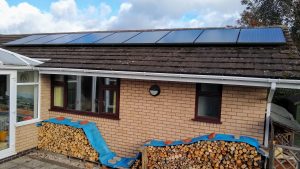
you might be interested in my write-up of our journey. We started with just solar, and added a battery a few years later. You don’t have to worry about your inverter, a separate one can be added for the battery.
https://www.rigdenage.co.uk/living-with-solar-pv/
-

I’m interested to understand your position of “avg use minus a bit” whereas we went for “avg use plus a bit” – that is, a dark gloomy day plus 2 nights. That is for psychological comfort mainly, I guess.
Do you think it should be less, in order to more closely get to optimum return?
At church we have a 21kWh battery which is ¼-⅓ our daily consumption. (22kWp solar.) If it were more than twice the size (48kWh) it would only increase the forecast self-use benefit by around 5%. I often wish it were bigger, though, because on a gloomy winter Sunday or Thursday it runs out before 11am!
So there could be something in what you say. Our 8kWh battery at home runs the house and heat pump, and runs out early a number of days in winter, though we only spend about £50 per winter on daytime electricity. So while it would be more satisfying to have a 12kWh or even 16kWh, it doesn’t seem economic to expand our system.
I’ll probably choose that in preference to a new kitchen, though!
But I’ve never heard of anyone *wishing* they had less battery capacity.
-

my guidance is to get value for money from your spend, so its around rightsizing the usable battery required for daily use on the basis it will be charged each night from the grid. If you get a battery bigger than your daily consumption then it will not only cost more but it will never be fully charged/discharged.
I haven’t factored in depth of discharge or max charge recommendations, just the capacity required.
The “minus a bit” is on the basis that on your worst solar days (dark days in mid winter) your solar will still produce something (my estimate is 10% of their capacity) so your 22kwp of solar should produce 2.2kwh on the worst days
-
In reality, there are several days where I produce little in winter, even with an 11.2kW system that can hit 70+kWh in summer. I guess it depends how keen you are to avoid peak rate usage. 13.5kWh useable (PW2) seems fairly optimal for me on a tariff that gives 5 hours of cheap rate (IOG). Our home usage in February averaged 16.6kWh (high 21.8kWh, low 13.2kWh). The worst generation day was 1.4kWh, the best 41.3kWh and the average 12.1kWh.
-
yes it’s a balance. If batteries were pennies we’d all go over the top, if they were priced like gold we’d make sure to size them perfectly. It’s the same then with utility costs if it was ££ per kWh we’d probably buy more batteries.
-
-

Battery Size mainly depends on how much electricity you use at night. Check your daily kWh usage and choose a battery that can cover the amount. For many homes , a 5-10 kWh battery is a common starting point, but it’s best to match it with your solar system and usage.

Log in to reply.